An ongoing story of my life in architecture school. #HamptonUniversity #Bemis #Architecture Updates every Monday, Wednesday and Friday.
Showing posts with label churches. Show all posts
Thursday, November 28, 2013
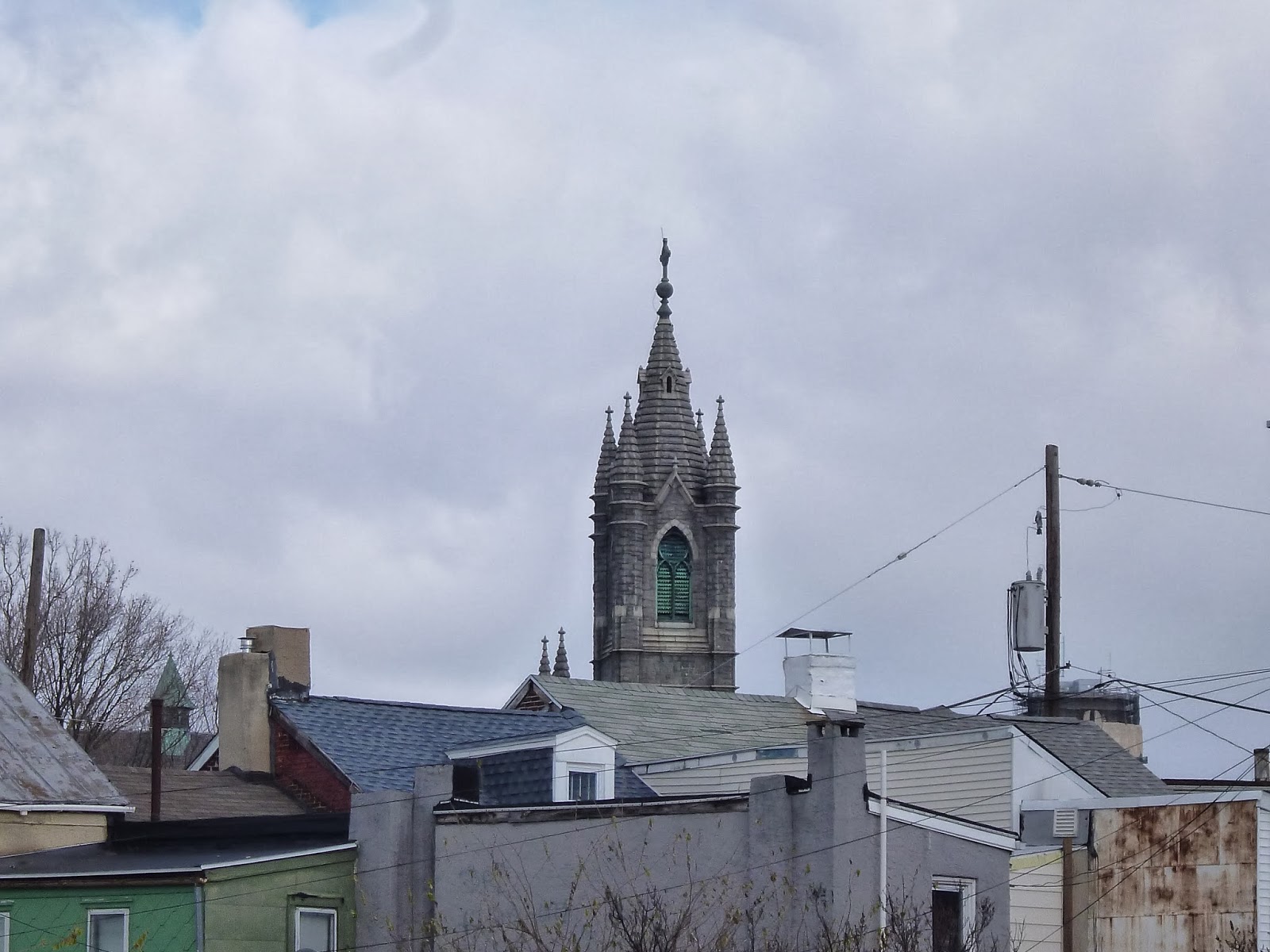
Thanksgiving in Reading
Thanksgiving traditionally makes you think of turkeys, cranberry sauce, and sweet potatoes. For me, Thanksgiving, like everything else, makes me think of architecture. Since I always travel to see family for Thanksgiving, I am always somewhere new, which gives me a chance to discover and analyse. I had been to Reading before, and i had been fascinated by the side alleys, the churches, and the industrial ghost town. I felt like there used to be thriving city, filled with action and life, that has disappeared. I sometimes wonder what Reading must have been like back in the day, when the factories were going in full swing and the buildings didn't look down at you with cold, empty eyes. Add to that the fact I was taking these pictures in the freezing rain, and even I begin to wonder why I didn't just stay inside. But the architecture wouldn't let me. For better or for worse, dead or alive, the architecture is there, and it's always trying to tell me its story...
Labels:
architectural details,
churches,
pa,
pennsylvania,
reading,
thanksgiving
Hampton, Virginia, USA
Reading, PA, USA
Wednesday, April 17, 2013
African-American Architects: William Sydney Pittman
William Sydney Pittman (April 21, 1875 - March 14, 1958) was an African American Architect from Alabama. He is known for being the first practicing African-American architect in the state of Texas. He was also the first African-American in the nation to win a federal contract to design a building in 1907. He is also notable for being both the mentee and son-in-law of Booker T. Washington.
![]() |
| Source: Dallas Observer |
![]() |
| Hume Hall Source: Delcampe.com |
He was also employed by the African-American architect John Lankford. William Pittman designed churches, schools, libraries, commercial buildings and fraternal buildings. Some examples of his work are the Allen Chapel African Methodist Episcopal Church, Garfield Elementary Public School, and the Washington D.C. 12th Street Y.M.C.A, and the building for the Grand United Order of Oddfellows (Negro).
![]() |
| Allen Chapel African Methodist Episcopal Church Source: Wikipedia |
One of his most famous buildings is the Knights of the Pythias Temple in Dallas, Texas which was the first major commercial structure built for African Americans, by African Americans, and with African American money. It is now the only building downtown to hold that distinction. It provided office space for prominent African American professionals, such as lawyers and doctors, and the top floor was used for social activities. The Colored Carnegie Library of Houston, located in Houston, Texas was the first library for African-Americans in Houston.
![]() |
| Pythian Temple Source: Flickr |
Tuesday, August 2, 2011
Discovering Richmond Part 3
We are once again in the Fan District for the third installment of the Discovering Richmond series. I am always drawn to this area, probably because it has the highest concentration of columns and porches in the Metro area. I took these pictures last winter to be honest, but they are no less interesting for being old.
For this set, I traveled down Boulevard. According to its Wikipedia entry it is a border between the Carytown/Museum District and the Fan District. It contains many architectural styles, including Late 19th And Early 20th Century American Movements, Late 19th And 20th Century Revivals, and Late Victorian.
For the architecture majors out there, I again promote taking as many pictures as possible. I'm considering making a facade catalog for myself, so i can use it for future Classical projects. It's also useful for letting you know what you can and can't do for windows. If you couldn't do it, then it wouldn't be built.
We once had a project where one of my classmates pretty much copied a building out right, and the professor showered him with praise. You might think this is cheating or selling out to your own creativity, but some professors are more interested in a good design than one you think is completely unique. Of course, the argument is that nothing is unique or original and that everything that can be done already has. Do not, however, let this discourage you. Some teachers want design that all comes from you, some want you to do something different using classical concepts and designs. It all really comes down to your professor.
Here are my photos and I hope you enjoy them. I definitely enjoyed taking them, despite the cold.
For this set, I traveled down Boulevard. According to its Wikipedia entry it is a border between the Carytown/Museum District and the Fan District. It contains many architectural styles, including Late 19th And Early 20th Century American Movements, Late 19th And 20th Century Revivals, and Late Victorian.
For the architecture majors out there, I again promote taking as many pictures as possible. I'm considering making a facade catalog for myself, so i can use it for future Classical projects. It's also useful for letting you know what you can and can't do for windows. If you couldn't do it, then it wouldn't be built.
We once had a project where one of my classmates pretty much copied a building out right, and the professor showered him with praise. You might think this is cheating or selling out to your own creativity, but some professors are more interested in a good design than one you think is completely unique. Of course, the argument is that nothing is unique or original and that everything that can be done already has. Do not, however, let this discourage you. Some teachers want design that all comes from you, some want you to do something different using classical concepts and designs. It all really comes down to your professor.
Here are my photos and I hope you enjoy them. I definitely enjoyed taking them, despite the cold.
| The first and last synagogue that I have seen in Richmond. |
| There are a lot of buildings dedicated to the Confederacy on this particular road. |
| Columns to die for! |
| Richmond has many examples of beautiful windows. |
| Daughters of the Confederacy Building |
| Christmas decorations everywhere, I think this was post-noel. |
| I love the style of this building, which is a stark contrast to the snow and cold that surrounds it. It made me feel warmer just looking at it. |
| The many details on this window are interesting, from the colored glass, to the carvings on top and the bright color of the window itself. |
| I would love to use this opening design in one of my buildings. It reminds me of many doors and windows I have seen in Islamic architecture. |
| I would hazard a guess that this facade is around 20 ft wide. |
| Another church, featuring trigylphs but no frieze. These buildings show many different examples for options for Classical design. |
| I shall follow that trail one day. |
| One of the many statues on Monument Ave. This one of Stonewall Jackson as you can see on the pedestal below. |
| The intersection of Monument Ave. and Boulevard |
| A Visual Arts Studio/Gallery |
Labels:
architecture,
Boulevard,
churches,
classical,
confederacy,
Discovering Richmond,
Fan district,
historical,
statues,
Stonewall Jackson,
street signs,
suzy of bemis,
synagogue,
Virginia,
windows
Hampton, Virginia, USA
Richmond, VA, USA
Subscribe to:
Posts (Atom)